The “Free” POS Equipment Myth: What Merchants Are Really Paying For
by Merchant Advocate
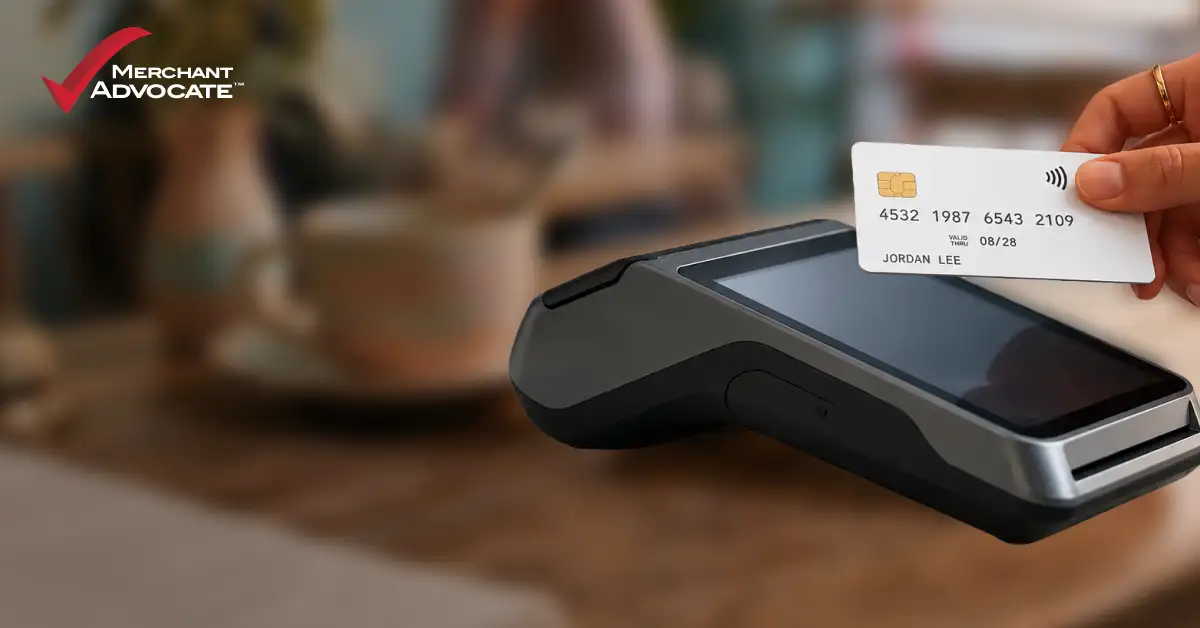
Business owners often hear the pitch: “We’ll give you a free POS system.” It sounds like a great deal. No upfront investment. No equipment purchase. No check to write.
But every business owner should ask: If the equipment is free, how is the provider making its money back? In many cases, the answer lies in the payment processing relationship—and the terms attached to it.
“Free” Usually Comes with a Trade-Off
Payment processors and merchant services providers have reasons to subsidize POS equipment. The hardware brings businesses into their ecosystem, while processing transactions generates revenue over time.
Some free-equipment programs require merchants to maintain an active processing account, meet minimum processing requirements, or remain under contract for a specified term.
“A free credit card terminal can be appealing,” says Kelly Sweeney, Merchant Advocate’s VP of Operations. “However, merchants should evaluate the entire processing relationship, not just the upfront cost of the hardware.”
That evaluation starts with understanding whether the equipment is provided at no charge, loaned to the business, or covered by a separate lease. Equipment offered with no upfront payment can still carry substantial costs over time.
“Processors make their money back through the terms attached to the equipment,” explains Aga Cabrita, Merchant Advocate’s VP, Director of Implementation. “For example, a terminal that costs $199 to $500 could come with a noncancelable, 48-month lease at $39.95 a month. That’s $1,917.60 for something you could have bought outright for a few hundred dollars.”
The equipment may have no upfront cost, but that doesn’t make the overall arrangement free.
The Real Cost Can Be in Your Processing Fees
Consider a business processing $1 million in card payments each year. If one processor’s effective rate is 0.25 percentage points higher than another’s, the difference is $2,500 a year. Over three years, at the same volume and rates, that adds up to $7,500. Suddenly, that “free” POS system doesn’t look quite so free.
Small differences in percentage rates, per-transaction fees, monthly fees, and other charges can add up across a business’s processing activity. That’s why looking only at the equipment price can be misleading. The larger financial question is what you’ll pay to accept card payments over time.
“A free POS system may save a few hundred dollars upfront, but even a small increase in processing fees can cost a business thousands over the life of the agreement,” says Sweeney.
Equipment and Contract Terms Can Limit Your Flexibility
Ownership is another consideration. Depending on the program, the provider may retain ownership of the equipment. When the processing relationship ends, you may have to return the device or pay a fee for failing to do so.
Other arrangements involve equipment leases that remain in effect even after you stop using the processor.
“You can also end up paying for equipment that becomes outdated before the lease is up,” warns Cabrita. “The terminal may be locked to the original processor, and the lease may be through a separate company, so ending your processing relationship doesn’t necessarily end your equipment payments.”
Contract terms can create additional obstacles. These may include early termination fees, clauses requiring payment of some or all remaining charges if you leave, and multiyear agreements that renew automatically. Even reaching month 48 may not stop the bills if the lease requires specific steps to cancel.
“Free equipment is rarely free,” says Cabrita. “The cost usually shows up somewhere else, in your rates, your fees, or your contract terms. It’s a sales tactic designed to get you excited up front and locked in for the long haul.”
Together, these terms can make switching processors more complicated—and more expensive—than it first appears.
Don’t Just Ask, “Is the POS Free?”
At Merchant Advocate, we encourage businesses to look at the full cost of their payment processing relationship when evaluating an equipment offer.
Before accepting a “free” POS proposal, ask:
- What will my total processing costs be, including all rates and fees?
- Is there a contract term or minimum processing requirement?
- Who owns the equipment?
- Is there a separate equipment lease?
- What happens if I switch processors?
- Are there early termination fees, equipment return fees, or remaining lease payments?
- Does the agreement renew automatically, and what steps are required to cancel?
- Are there monthly, statement, PCI, or other account fees?
- What will this arrangement cost my business over one, three, or five years?
Those answers tell you far more than a “free equipment” headline.
Look Beyond the Upfront Price
There is nothing inherently wrong with a provider offering equipment at no upfront cost. The right equipment program can be valuable, but a $0 upfront price doesn’t tell you what the full arrangement will cost.
Businesses should understand what they’re paying for, how their processing costs are structured, and whether the overall agreement makes financial sense.
“Transparency matters,” says Sweeney. “When businesses understand exactly what they’re paying for and how their fees are structured, they can make decisions based on long-term value rather than short-term equipment incentives.”
The best deal is the one that leaves your business with more money in the long run.
Merchant Advocate helps businesses analyze payment processing costs, identify potential savings, and understand the terms of their merchant services agreements—all without switching processors. Request a complimentary, no-obligation analysis at merchantadvocate.com.