Surcharging Doesn’t Eliminate Fees.
See What You’re Really Paying.
Most businesses still overpay even with a surcharge program.
Find Out If You’re Overpaying on Credit Card Fees
We’ll review your surcharging or cash discounting program and credit card processing statement to identify hidden fees, calculate your true rate, and show where you can save.
- No processor switch required
- No upfront cost
- You only pay if we find savings
How Credit Card Surcharging Actually Works
Passing credit card fees on to customers, commonly known as surcharging, has become increasingly popular across a multitude of industries, with one third of small businesses reporting they have a surcharge program (J.D. Power Survey, 2025). But are these businesses truly saving money? Before implementing a surcharge or cash discount program, make sure you understand the risks. Many businesses don’t realize how much their payment processor benefits, and often at their expense.
Surcharge Fees 101: Are You Actually Saving?
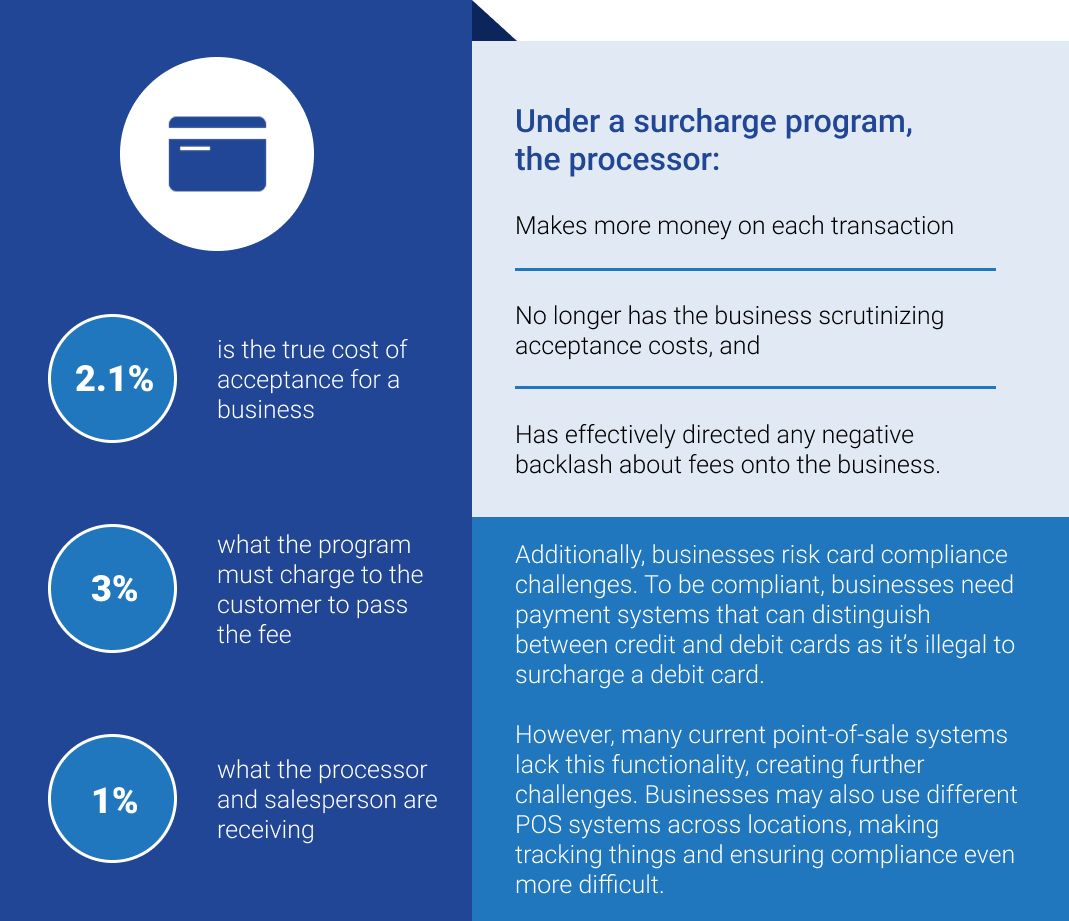
It might seem like passing fees to customers helps your bottom line, but in reality, processors profit the most. Most surcharge programs increase processor revenue while leaving businesses exposed to additional risks.
-

Customer pushback on pricing
-

Compliance risks with Visa, Mastercard, and state laws
-

Hidden financial impact on long-term profitability
It might seem like the merchant wins by passing processing costs to their customers, but surcharge programs actually benefit the processor far more than the businesses that adopt them. These programs apply a flat fee on credit card transactions that often exceeds the actual cost of acceptance.
You Could Be Losing Money Without Realizing It
- Hidden fees still apply
- Processors increase margins
- Surcharging doesn’t fix pricing
Surcharging Comes with Strict Rules
State laws and card network regulations on surcharges vary. Failure to comply can result in fines or even loss of processing privileges.
How This Can Go Wrong
A business owner was misled by their processor about state surcharge rules. If they had implemented the program, they would have been in violation as of July 1, 2025. Avoid costly mistakes by getting an expert review of your surcharge program today.
Don’t Risk a Costly Compliance Mistake
Don't Overlook the Tax and Reporting Responsibilities
Implementing a surcharge program involves additional tax reporting requirements. Payment processors and card networks typically require businesses to provide advance notice when adding a surcharge.
Additionally, businesses must accurately report surcharge revenue on their tax forms, including 1099-K filings, to avoid audits or penalties.Understanding these obligations is essential to maintain compliance and financial accuracy.
Cash Discount Programs - A Safer Alternative?
Learn About Cash Discounting: Reduce Costs Without Risk
Cash discount programs allow businesses to offer a price reduction for customers who pay with cash, rather than adding extra fees to card transactions. However, some programs misrepresent themselves as compliant when they are not.
To ensure compliance:

Display full-service prices and apply the discount only to cash payments

Avoid deceptive pricing that functions like an illegal surcharge

Use compliant technology to handle fee tracking automatically
A Better Way to Reduce Credit Card Fees
Before adding fees to your customers, most businesses can reduce costs by fixing pricing issues secretly built into their processing.